Isaiah 36–37
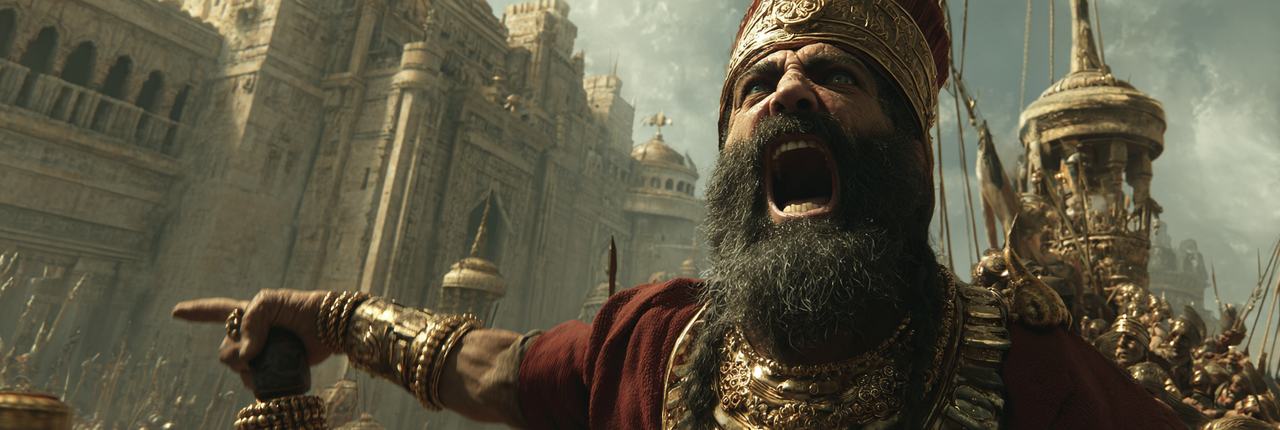
Whom have you taunted and blasphemed? It is against the Holy One of Israel.
Narrator
In the 14th year of King Hezekiah, Sennacherib the king of Assyria came up against all the fortified cities of Judah and captured them.
The king of Assyria then sent the Rabshakeh with a vast army from Lachish to King Hezekiah in Jerusalem. They took up a position by the conduit of the upper pool, which is at the highway of the laundryman’s field. Then Eliakim son of Hilkiah, who was in charge of the household, Shebna the secretary, and Joah son of Asaph the recorder came out to him.
Rabshakeh
“Please, say to Hezekiah, ‘This is what the great king, the king of Assyria, says: What is the basis for your confidence? You are saying, “I have a strategy and the power to wage war,” but these are empty words. In whom have you put trust, so that you dare to rebel against me?
Look! You trust in the support of this crushed reed, Egypt, which if a man should lean on it would enter into his palm and pierce it. That is the way Pharaoh king of Egypt is to all those who trust in him.
And if you should say to me, “We trust in Jehovah our God,” is he not the one whose high places and altars Hezekiah has removed, while he says to Judah and Jerusalem, “You should bow down before this altar”?
So now make this wager, please, with my lord the king of Assyria: I will give you 2,000 horses if you are able to find enough riders for them. How, then, could you drive back even one governor who is the least of my lord’s servants, while you put your trust in Egypt for chariots and for horsemen?
Now is it without authorization from Jehovah that I have come up against this land to destroy it? Jehovah himself said to me, “Go up against this land and destroy it.”’”
Eliakim, Shebna, and Joah
“Speak to your servants, please, in the Aramaic language, for we can understand it; do not speak to us in the language of the Jews in the hearing of the people on the wall.”
Rabshakeh
“Is it just to your lord and to you that my lord sent me to speak these words? Is it not also to the men who sit on the wall, those who will eat their own excrement and drink their own urine along with you?”
Narrator
Then the Rabshakeh stood and called out loudly in the language of the Jews, saying:
Rabshakeh
“Hear the word of the great king, the king of Assyria. This is what the king says, ‘Do not let Hezekiah deceive you, for he is not able to rescue you. And do not let Hezekiah cause you to trust in Jehovah by saying: “Jehovah will surely rescue us, and this city will not be given into the hand of the king of Assyria.”
Do not listen to Hezekiah, for this is what the king of Assyria says: “Make peace with me and surrender, and each of you will eat from his own vine and from his own fig tree and will drink the water of his own cistern, until I come and take you to a land like your own land, a land of grain and new wine, a land of bread and vineyards.
Do not let Hezekiah mislead you by saying, ‘Jehovah will rescue us.’ Have any of the gods of the nations rescued their land out of the hand of the king of Assyria? Where are the gods of Hamath and Arpad? Where are the gods of Sepharvaim? And have they rescued Samaria out of my hand?
Who among all the gods of these lands have rescued their land out of my hand, so that Jehovah should rescue Jerusalem out of my hand?”’”
Narrator
But they kept silent and did not say a word to him in reply, for the order of the king was, “You must not answer him.”
But Eliakim son of Hilkiah, who was in charge of the household, Shebna the secretary, and Joah son of Asaph the recorder came to Hezekiah with their garments ripped apart and told him the words of the Rabshakeh.
Isaiah 37
Narrator
As soon as King Hezekiah heard this, he ripped his garments apart and covered himself with sackcloth and went into the house of Jehovah.
Then he sent Eliakim, who was in charge of the household, Shebna the secretary, and the elders of the priests, covered with sackcloth, to the prophet Isaiah, the son of Amoz.
Eliakim and the Delegation (Message from Hezekiah)
“This is what Hezekiah says, ‘This day is a day of distress, of rebuke, and of disgrace; for the children are ready to be born, but there is no strength to give birth. Perhaps Jehovah your God will hear the words of the Rabshakeh, whom the king of Assyria his lord sent to taunt the living God, and he will call him to account for the words that Jehovah your God has heard. So offer up a prayer in behalf of the remnant who have survived.’”
Narrator
So the servants of King Hezekiah went in to Isaiah.
Isaiah
“This is what you should say to your lord, ‘This is what Jehovah says: “Do not be afraid because of the words that you heard, the words with which the attendants of the king of Assyria blasphemed me. Here I am putting a thought in his mind, and he will hear a report and return to his own land; and I will make him fall by the sword in his own land.”’”
Narrator
After the Rabshakeh heard that the king of Assyria had pulled away from Lachish, he returned to him and found him fighting against Libnah.
Now the king heard it said about King Tirhakah of Ethiopia: “He has come out to fight against you.” When he heard this, he sent messengers again to Hezekiah, saying:
Messengers of the King of Assyria
“This is what you should say to King Hezekiah of Judah, ‘Do not let your God in whom you trust deceive you by saying: “Jerusalem will not be given into the hand of the king of Assyria.” Look! You have heard what the kings of Assyria did to all the lands by devoting them to destruction. Will you alone be rescued?
Did the gods of the nations that my forefathers destroyed rescue them? Where are Gozan, Haran, Rezeph, and the people of Eden who were in Tel-assar? Where is the king of Hamath, the king of Arpad, and the king of the cities of Sepharvaim, and of Hena, and of Ivah?’”
Narrator
Hezekiah took the letters out of the hand of the messengers and read them. Hezekiah then went up to the house of Jehovah and spread them out before Jehovah.
And Hezekiah began to pray to Jehovah and say:
Hezekiah
“O Jehovah of armies, the God of Israel, sitting enthroned above the cherubs, you alone are the true God of all the kingdoms of the earth. You made the heavens and the earth.
Incline your ear, O Jehovah, and hear. Open your eyes, O Jehovah, and see. Hear all the words that Sennacherib has sent to taunt the living God.
It is a fact, O Jehovah, that the kings of Assyria have devastated all the lands, as well as their own land. And they have thrown their gods into the fire, because they were not gods but the work of human hands, wood and stone. That is why they could destroy them.
But now, O Jehovah our God, save us out of his hand, so that all the kingdoms of the earth may know that you alone are God, O Jehovah.”
Narrator
Isaiah son of Amoz then sent this message to Hezekiah:
Isaiah
“This is what Jehovah the God of Israel says, ‘Because you prayed to me concerning King Sennacherib of Assyria, this is the word that Jehovah has spoken against him:
“The virgin daughter of Zion despises you, she scoffs at you. The daughter of Jerusalem shakes her head at you.
Whom have you taunted and blasphemed? Against whom have you raised your voice And lifted your arrogant eyes? It is against the Holy One of Israel!
Through your servants you have taunted Jehovah and said, ‘With the multitude of my war chariots I will ascend the heights of mountains, The remotest parts of Lebanon. I will cut down its lofty cedars, its choice juniper trees. I will enter its highest retreats, its densest forests.
I will dig wells and drink waters; I will dry up the streams of Egypt with the soles of my feet.’
Have you not heard? From long ago it was determined. From days gone by I have prepared it. Now I will bring it about. You will turn fortified cities into desolate piles of ruins.
Their inhabitants will be helpless; They will be terrified and put to shame. They will become as vegetation of the field and green grass, As grass of the roofs that is scorched by the east wind.
But I well know when you sit, when you go out, when you come in, And when you are enraged against me, Because your rage against me and your roaring have reached my ears. So I will put my hook in your nose and my bridle between your lips, And I will lead you back the way you came.”
“‘And this will be the sign for you: This year you will eat what grows on its own; and in the second year, you will eat grain that sprouts from that; but in the third year you will sow seed and reap, and you will plant vineyards and eat their fruitage.
Those of the house of Judah who escape, those who are left, will take root downward and produce fruit upward. For a remnant will go out of Jerusalem and survivors from Mount Zion. The zeal of Jehovah of armies will do this.
Therefore this is what Jehovah says about the king of Assyria:
“He will not come into this city Or shoot an arrow there Or confront it with a shield Or cast up a siege rampart against it.
By the way he came he will return; He will not come into this city,” declares Jehovah.
“I will defend this city and save it for my own sake And for the sake of my servant David.”’”
Narrator
And the angel of Jehovah went out and struck down 185,000 men in the camp of the Assyrians. When people rose up early in the morning, they saw all the dead bodies.
So King Sennacherib of Assyria departed and returned to Nineveh and stayed there.
And as he was bowing down at the house of his god Nisroch, his own sons Adrammelech and Sharezer struck him down with the sword and then escaped to the land of Ararat. And his son Esar-haddon became king in his place.