Nothing Left But the Foundation
SSDD
Dad is ticked off at Uncle David.
As the oldest, my father has the same tenacious streak that I do, though his was forged in harder fire. To him, hardship is not a thing to be feared. It is an activity to engage. A job to be done. A thing you put your shoulder into until it moves or you do.
When his father died, Dad was only nine years old.
Nine.
Old enough to remember. Too young to understand. Too young to be a man, but somehow old enough to start doing a man’s work.
After that, he soldiered on and kept track of his three younger brothers: Ricky, David, and Willy.
Ricky eventually became a restaurant manager. And one role turned into a life until he ended up in Florida and retired after what seems to have been a solid, respectable career. David is retired too, though I am less sure from what. Manufacturing, maybe. Retail. Dust, mostly. Willy was the baby, and Willy is gone now. A lifelong drug addict. Dead before he ever really escaped whatever had its teeth in him.
The four boys grew up on the east side of town, in the projects, on what Dad always called the black side of town. Only a 10m walk from where I grew up. It's interesting that he left it behind, but not too far. He has wild stories from those years. Stories that sound impossible until you remember they happened to boys who were expected to become men before they could even shave.
One of the worst was at the drive-in on MLK Boulevard.
Dad was there with friends when one of them got into a fight with a fellow named Squeaky. It should have been a fistfight. One of those stupid, hot-blooded teenage things that ends with a bloody nose, a torn shirt, maybe somebody’s pride getting dragged through the gravel.
But Squeaky brought a knife.
He stabbed Dad’s friend and killed him.
That was the world my father came up in. A world where boyhood could end in a parking lot. Where death did not wait politely for people to be ready. Where fathers disappeared and sons got drafted and friends bled out beneath the glow of a movie screen.
The four brothers survived that.
First Dad was drafted and sent to Vietnam. He did his two years, came back, and said, essentially, to hell with that.
But he had done it.
Whatever he thought of the war, the Army, the government, the jungle, the whole machine of it, he finished what had been put in front of him. Then he came home and became a highly skilled welder. He built a life with his hands. A hard life, maybe. A flawed one. But a life made by work, not complaint.
His brothers saw that success and joined the Marines.
Each of them, in short order, came to the same conclusion Dad had: to hell with that.
Only they did not finish. I am not sure what the proper term is when you volunteer for the military and do not complete your service. I assume this was after Vietnam, but what do I know? I am guessing from the scraps I have been given.
The point is, Dad always came down hard on his brothers for that. In his mind, they showed a lack of character.
And considering their childhood, one could understand why they struggled. But Dad had his own childhood too. Dad had his own dead father. Dad had his own fear, poverty, violence, and war. Dad had his duty behind him.
So who am I to question how he judged his little brothers?
Ricky seemed to be the one, besides Dad, who had his act together. He made a career out of managing successful restaurants and finally retired. His sons seem to be doing all right, though I have not seen any of them in decades. His wife died of cancer about ten years ago.
David’s wife divorced him thirty years back and, by all reports, found life afterward to be amazing and better.
Willy married Lucy, who was chaos in lipstick. Dad says, “I think Willy would have finished his military service, but Lucy was always bitching about him being gone.”
Maybe she was the disaster. Maybe Willy was already one.
Lucy was nuts, no question. She stabbed him more than once. But I always liked her. I thought she was pretty, and she was always nice to me, which is one of those confusing childhood facts that never quite fits with the adult version of the story.
I lost track of all my paternal cousins. They were fine and decent, I guess. But the truth puts us on our own track, and I was pretty self-righteous when I was younger.
What are you going to do?
This week, Dad was trying to learn more about his father’s military service and history. Just out of curiosity, maybe. Or maybe because a man gets older and starts looking backward for the men who made him. He contacted the Department of Veterans Affairs and did some online research, but not much came of it.
Then he was talking to Uncle David and learned that David had once had my grandfather’s military records. His uniform too. Even his dog tags.
All gone now.
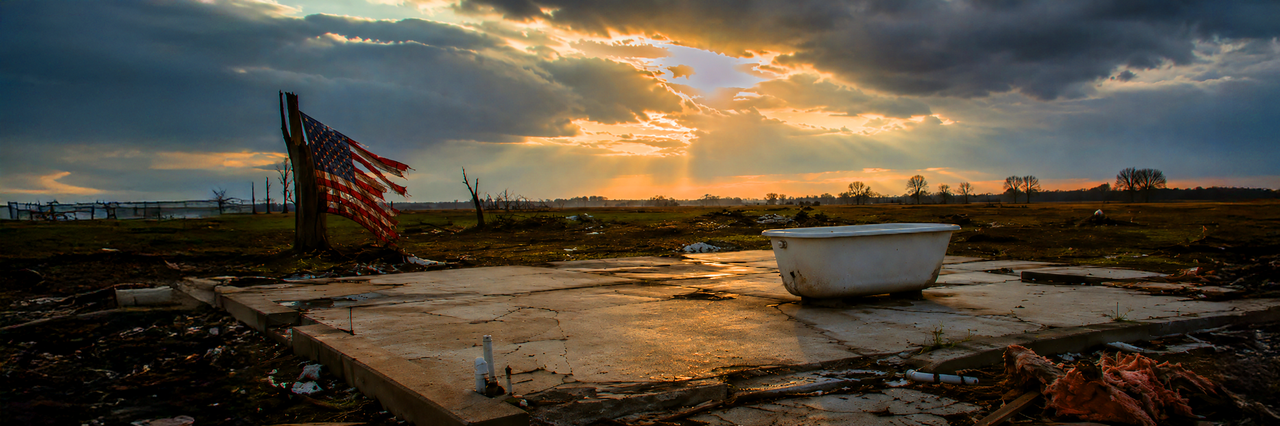
They were lost in the big tornado of 1979.
That tornado scraped my uncle’s house clean. Nothing left but the bathtub, the toilet, and the foundation.
That image stays with me.
Nothing left but the bathtub, the toilet, and the foundation.
It sounds almost comic until it becomes biblical. A whole house erased. A family’s proof lifted into the sky and scattered across the county. The uniform gone. The records gone. The dog tags gone. The relics of a dead father gone.
Dad was upset that David had them in the first place.
He felt my grandmother should have given those things to him.
And honestly, I understand it. Dad was the oldest. Dad was the one who remembered. Dad was the one who had been forced, at nine years old, to become something like the man of the house. Maybe he feels he paid for those relics. Not with money, but with childhood. Maybe he feels that if anyone should have been trusted with the proof of his father, it should have been him.
Maybe he is angry at David because the tornado took what David had no right to hold.
Or maybe he is angry because there is no one else to be angry at.
Uncle David was always kind of weird to me. When we were kids, he had this huge wall of VHS tapes at a time when we could not afford a VCR, much less tapes. But they were all awful films I had no desire to watch. The Mist. Amityville Horror. The Texas Chain Saw Massacre. Horror and slasher films. All of it.
I have never liked stuff like that.
It scares the shite out of me. No thanks. Ever. For any reason.
Because of that, I always thought of Uncle David as a weirdo to be avoided.
His son Brian, two years younger than me, was big into Megadeth and other death-metal bands. He always had the grossest posters hanging all over his room. Skulls, blood, monsters, whatever else boys use to decorate the room where their fear lives.
Looking back, I remember David and Kim and their kids as having more money than we did. Ricky too. Only Willy and Lucy seemed poorer than us.
But Dad says David’s big complaint now is that he is broke, and he is frustrated at the government for taking everything he has. He wants to know why Dad seems so well off.
Dad is not well off.
But David has the disease of victimhood.
When you are a nail, everything looks like a hammer.
And that may be the real divide between them. Not money. Not military service. Not even who had the records.
Some men survive hardship and turn it into duty.
Some men survive hardship and turn it into grievance.
Feeling sorry for yourself is human. God knows we all do it. Sometimes life hits hard enough that self-pity is not weakness; it is just bruising. It is the body counting where it hurts.
But living there is surrender.
The moment every roadblock becomes somebody else’s fault, you hand them the keys to your cage and call it politics, luck, government, family, history — anything but choice.
My father has many faults.
But he never handed over the keys.
No victim.
Never a victim.